Two vials of clear water sit on the shelf. They look identical, they cost about the same, and one is the wrong tool for the job. The difference is one line of small print.
The one line
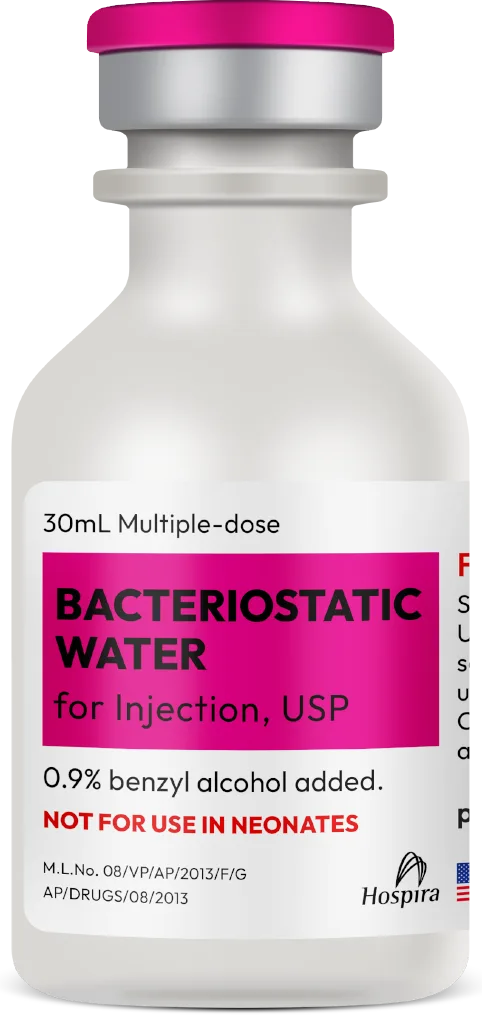
Sterile Water for Injection is water. Nothing else. Bacteriostatic Water for Injection is that same water with 0.9% benzyl alcohol added, and that alcohol is a preservative. It does not kill what is already in the vial. It holds bacteria back from multiplying, which is what bacteriostatic means.
The manufacturer says the consequence out loud: bacteriostatic water is supplied in a multiple-dose container from which repeated withdrawals may be made. Sterile water carries no such sentence. Every needle across the stopper drags room air in with it, and the preservative is what keeps the vial from becoming a culture. Without it, the first puncture is the only one the vial was built for.
Where the 28 days comes from
The number is real, and it is not about your peptide. Twenty-eight days is a beyond-use date for a preserved multiple-dose vial, and it answers one question: when do repeated punctures push infection risk past acceptable. That is a question about bacteria, not about whether the compound still does anything.
A real answer looks like the drugs that paid for one. A peer-reviewed protocol for a lyophilized biologic mixed with bacteriostatic water states it plainly: stability data support storage of reconstituted solution at 2 to 8 degrees Celsius, up to 28 days. That is a funded cancer therapy, not a vial off a research site.
What actually decides it
The two bottles look the same on a shelf and read almost the same on the label. Only one is the multiple-dose preparation. If a vial gets entered more than once, the preservative is the reason that is supported rather than hoped.
The manufacturer's instruction is to cleanse the stopper with antiseptic on every entry, not just the first. The preservative buys time. It does not sterilize what you push through the rubber. The 28 days assumes you did your part.
Heat is the one that moves. Degradation roughly doubles for every 10 degrees Celsius, so a vial on a warm counter is not slightly worse off than one in the fridge. It is on a different clock. Cold is the biggest thing in your control.
After heat comes light, oxygen, and moisture. None of them announce themselves. A vial in its box in the fridge is doing better than one on a windowsill, and nothing on the outside of either will tell you which is which.
And your vault already counts
Knowing the floor is the mindset. Tracking it is the tool. Seal a vial in TR8CE and the clock starts itself: the shelf reads Fresh, then Good, then Use soon, so you see where every vial stands at a glance instead of remembering which Sunday you mixed it.
Let the vault keep the clock
Seal a vial. It tracks the days, the doses, and the math for you.
Open your BioVaultWhat this does not support
- This explains what two products are and where a number came from. It is general reference for research handling, not a protocol, not a dosing recommendation, and not medical advice.
- Bacteriostatic Water for Injection is a prescription product. Nothing here is an instruction to obtain it or to administer anything to a person.
- Label text and quotations come from the manufacturer's published prescribing information, shown for reference. No affiliation with or endorsement by any manufacturer is implied.
- The 28-day figure is a microbial limit for a preserved vial. It is not a guarantee of potency, and no article can tell you the real stability of a compound nobody has studied.
- The published stability data quoted here belongs to a specific approved biologic and its formulation. It does not transfer to a research compound.
- Storing a vial correctly does not verify what is inside it. That is what a lab report is for.
- Research compounds are not for human consumption. Consult a qualified professional.